




1 Dikki Saputra
2 Yuliani Purnaningsih
3 Hafizul Makruf
3 STIKes Medika Seramoe Barat, Aceh Barat, Indonesia




Yuliani Purnaningsih
RSD K.R.M.T. Wongsonegoro Hospital, Department of Nursing, Semarang, Indonesia E-mail: yulianiyuli07@gmail.com



Introduction. Family members of Intensive Care Unit (ICU) patients often face emotional distress from lim- ited access to patient information. The SI RINDU mo- bile application was developed to bridge this gap by providing real-time updates on patient status and care.
Aim. This study aimed to evaluate the user experience of family members using the SI RINDU application.
Methods. An exploratory user experience study was conducted over a 14-day period in January 2025 at the Intensive Care Unit of a regional hospital in Semarang, Indonesia. A total of 20 family representatives of In- tensive Care Unit patients who used the SI RINDU ap- plication participated. User experience was assessed using the User Experience Questionnaire (UEQ), which measures six dimensions: Attractiveness, Perspicuity, Efficiency, Dependability, Stimulation, and Novelty.
Results. All six dimensions recorded mean scores above 0.8, indicating a generally positive user experience. The highest scores were in Attractiveness (1.592), Novelty (1.538), and Efficiency (1.513), suggesting that us- ers appreciated the application’s design, usefulness, and innovation. Stimulation (1.263) and Dependability (1.188) were also rated positively. However, Perspicu- ity scored lower (1.125), reflecting some challenges with interface clarity and usability. Benchmark analysis categorized most dimensions as “Good” or “Above Aver- age,” with Perspicuity rated “Below Average.”
Conclusion. The SI RINDU application provides a promising tool for enhancing family engagement and emotional support in Intensive Care Unit settings through effective digital communication. While us- ers generally responded positively, improvements in interface clarity and navigation are recommended to enhance accessibility and overall user satisfaction.


The Intensive Care Unit (ICU) is a vital part of the healthcare system, treating patients with critical or life-threatening conditions. In the ICU, patients re- ceive intensive care supported by advanced tech- nology, complex medical interventions, and strict, continuous monitoring protocols (1,2). While these facilities are designed to improve the chances of re- covery, the closed, high-intensity environment of the ICU often has psychosocial consequences, not only for patients but also for their families (1,3).
One of the main challenges in ICU care is limited family access to patients and information regarding their condition. Limited visitation and strict isolation protocols, particularly in the context of a pandemic or nosocomial infection, often leave families feeling marginalized in the care process. This communication gap has been shown to increase stress, anxiety, and the emotional burden on families, who feel a loss of control and clarity regarding their loved one’s condi- tion (4,5). In fact, this uncertainty in information of- ten leads to a decline in family quality of life and dis- satisfaction with overall hospital services (6,7).
In the context of critical care, the need for accurate, consistent, and up-to-date information is a crucial aspect in supporting family emotional well-being. Ef- fective communication has been recognized as a key element of a family-centered care model, where ac- tive family involvement in understanding the patient’s condition is considered to increase satisfaction, collab- orative decision-making, and trust in the medical team
(8). Research by Białek (2021), confirms that providing structured information on a regular basis can reduce anxiety and increase families’ sense of calm and confi- dence in facing critical situations. However, there is a perception gap between families and healthcare pro- fessionals, particularly nurses, regarding the type and frequency of information deemed important to con- vey (10). Nurses often focus on clinical aspects, while families require a more comprehensive and ongoing understanding of the patient’s condition.
To address these communication challenges, digital transformation in healthcare has opened up innovative opportunities through the development of the Hospi- tal Management Information System (SIMRS) (11,12). One SIMRS-based application specifically designed to
increase family involvement in ICU patients is the Inte- grated Daily Information System (SI RINDU). SI RINDU provides real-time information on the patient’s gen- eral status, current diagnosis, supporting test results, and treatment plan, which families can access digitally
(13). This innovation aims to improve communication, satisfaction, and emotional support for families of ICU patients. The application is expected to bridge the in- formation gap between medical personnel and fami- lies and provide a more optimal sense of involvement, reassurance, and emotional support (14–16).
Given the crucial role of digital applications in im- proving service quality, user experience evaluation is crucial to ensure the application is effective, easy to use, and meets the emotional and informative needs of users.


This study aims to explore in-depth the experiences of ICU patient families in using the SI RINDU applica- tion, employing the User Experience Questionnaire (UEQ) instrument to assess aspects of usability, ef- ficiency, information clarity, and visual appeal. The results of this study are expected to provide recom- mendations for system optimization, while enriching the literature related to digital innovation in sup- porting communication and the well-being of patient families in the ICU environment.


This study employed an exploratory user experience evaluation design using the User Experience Ques- tionnaire (UEQ) to assess how family members of ICU patients perceive the SI RINDU mobile information system. The study was conducted at the Intensive Care Unit (ICU) of RSD K.R.M.T. Wongsonegoro, Sema- rang, Indonesia, over a 14-day period from January 2 to January 16, 2025.
Participants were recruited using simple random sam- pling. Inclusion criteria included: (1) being the designat- ed family representative of an ICU patient; (2) actively receiving SI RINDU updates; and (3) owning an Android smartphone capable of running the application. A total of 20 participants met these criteria and consented to participate. Although modest in size, the sample is con- sidered adequate for exploratory user experience re- search, as previous studies suggest 20–30 respondents are sufficient for valid interpretation using UEQ (17).
The study population during the 14-day period con- sisted of 45 family representatives who were actively using the SI RINDU application. The simple random sampling method was chosen to minimize potential bias from specific usage patterns or initial enrollment periods, resulting in a sample size of N=20, which is considered adequate for exploratory UEQ testing. The questionnaire was administered to the participants in person at the hospital’s waiting room after they had used the application for at least 7 days. To ensure
This study involved family members of patients who voluntarily completed a questionnaire. Written in- formed consent was obtained from all participants. At the time the study was conducted, there was no insti- tutional ethics committee available; nevertheless, the research was carried out in accordance with the ethi- cal principles of the Declaration of Helsinki. Participant confidentiality and anonymity were strictly maintained.
Responses were analyzed using the official UEQ Da- ta Analysis Tool (Excel-based), available from www. ueq-online.org, which calculates mean scores, stand- ard deviations, confidence intervals, and benchmark- based interpretations for each scale dimension.

anonymity, participants filled out the paper-based questionnaire independently in a private corner, and
the forms were immediately sealed in an envelope without collecting identifying personal data, thereby maintaining strict confidentiality. The 20 participants consisted of 8 (40%) men and 12 (60%) women. The average age of the respondents was 45.2 years (SD = 12.5). Their relationship to the patient was primarily the spouse (n = 10, 50%), followed by the adult child (n = 6, 30%), and the parent or sibling (n = 4, 20%).
The UEQ instrument, developed by Laugwitz et al. 2008 (18), consists of 26 items in the form of seman- tic differential pairs, assessing six dimensions: Attrac- tiveness, Perspicuity, Efficiency, Dependability, Stimu- lation, and Novelty. The instrument’s reliability and validity have been confirmed through prior usability evaluations (17). Each item presents two opposing ad- jectives (e.g., “annoying” vs. “enjoyable”) and is rated on a 7-point Likert scale (ranging from -3 to +3, result- ing in a total score range of -3 to +3 for each scale). The mean scores for each dimension are calculated, with values ranging from -3 (extremely negative) to
+3 (extremely positive). For example, the Perspicuity scale consists of 4 pairs of adjectives, including “easy to learn” vs. “difficult to learn,” and measures the us- er’s perception of interface clarity and ease of under- standing. The Attractiveness scale also consists of 6 pairs (e.g., “unpleasant” vs. “pleasant”).

The study involved 20 participants who evaluated the SI RINDU application using the User Experience Ques- tionnaire (UEQ). All six UEQ dimensions had mean scores greater than 0.8, indicating a generally posi- tive user experience. The highest mean scores were observed for Attractiveness (1.592), Novelty (1.538),
and Efficiency (1.513) (Table 1). Figure 1 presents the mean scores for each of these dimensions.
As shown in Figure 1, the bars represent mean scale scores, ranging from -2 to +2. The color background indicates the interpretation range: Green (positive user experience), Yellow (neutral/borderline), and Red (negative user experience). All mean scores were in the positive (Green/Yellow) range.
A benchmark comparison was also conducted using the UEQ tool. The results are shown in Table 2.
As shown in Table 2, the SI RINDU application dem- onstrated “Good” performance. The “Comparison to benchmark” column refers to the classification of the SI RINDU results relative to a large dataset of results. The 5 categories of classification are Excellent, Good, Above Average, Below Average, and Bad, indicating the percentile rank of the product’s score against the benchmark distribution.
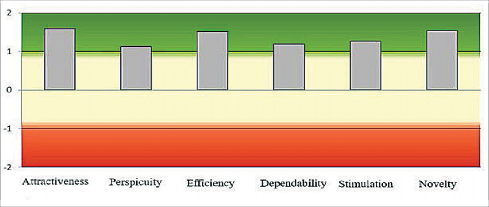
Figure 1. Mean scores across six dimensions of the User Experience Questionnaire (UEQ)


This study aimed to explore the user experience of the SI RINDU application as perceived by family members of patients admitted to the ICU. The find- ings suggest that the application delivers a generally positive user experience across all six dimensions of the User Experience Questionnaire (UEQ), with all mean values exceeding the threshold of 0.8, indicat- ing satisfactory usability and engagement.
The highest score was obtained in the Attractiveness dimension (M = 1.592), reflecting a strong positive impression of the application’s visual appeal and overall design. Prior research has established that first impressions play a critical role in shaping long- term user evaluations of digital interfaces (19,20). Visual aesthetics, interface simplicity, and layout co- herence have been shown to influence users’ initial trust and willingness to engage with digital health platforms. The strong performance in this dimension suggests that SI RINDU successfully captures users’ attention and fosters positive perceptions from the
Table 1. Descriptive statistics and score ranges for UEQ dimensions (N = 20) | |||||
Scale | Mean | Std. Dev. | N | Minimal Score (Sample) | Maximal Score (Sample) |
Attractiveness | 1.592 | 0.951 | 20 | –0.50 | 3.00 |
Perspicuity | 1.125 | 1.231 | 20 | –1.25 | 3.00 |
Efficiency | 1.513 | 0.982 | 20 | –0.75 | 2.75 |
Dependability | 1.188 | 0.743 | 20 | –0.50 | 2.50 |
Stimulation | 1.263 | 1.011 | 20 | –1.00 | 2.75 |
Novelty | 1.538 | 0.871 | 20 | –0.75 | 2.75 |
Table 2. UEQ Benchmark Comparison | |||
Scale | Mean | Comparison to benchmark | Interpretation |
Attractiveness | 1.59 | Good | 10% of results better, 75% of results worse |
Perspicuity | 1.13 | Below Average | 50% of results better, 25% of results worse |
Efficiency | 1.51 | Good | 10% of results better, 75% of results worse |
Dependability | 1.19 | Above Average | 25% of results better, 50% of results worse |
Stimulation | 1.26 | Above Average | 25% of results better, 50% of results worse |
Novelty | 1.54 | Good | 10% of results better, 75% of results worse |
outset, which is particularly crucial in emotionally charged environments such as the ICU.
In addition, high scores were observed in the Effi- ciency (M = 1.513) and Novelty (M = 1.538) dimen- sions. These results highlight the application’s ability to provide streamlined access to relevant information and its innovative features that address user needs in a novel way. In the context of critical care, where timely and accurate information is essential for fam- ily members’ emotional and cognitive processing, these attributes are particularly valuable. Efficient navigation and up-to-date content can facilitate in- formed decision-making, reduce anxiety, and pro- mote a sense of inclusion in the care process.
The Stimulation (M = 1.263) and Dependability (M = 1.188) dimensions also received favorable ratings, indicating that users found the application both en- gaging and reliable. These findings are consistent with literature suggesting that emotionally support- ive and technically dependable digital platforms can enhance user confidence and long-term engagement
(18). The ability of the application to stimulate inter- est and reinforce user trust underscores its potential for sustained use in high-stress healthcare environ- ments.
However, the lowest mean score was recorded in the Perspicuity dimension (M = 1.125), categorized as “below average” in UEQ benchmark classifications. This indicates some difficulty among users in under- standing how to navigate the application, interpret its content, or interact with its interface. Such issues may stem from a lack of onboarding support, the use of unfamiliar medical terminology, or suboptimal in- terface intuitiveness. Addressing these usability barriers is critical, especially considering the diverse digital literacy levels among users. Improving clarity through intuitive design, simplified language, and user-centered instructional materials could signifi- cantly enhance accessibility and overall experience.
Although the sample size was relatively small (n = 20), the study remains methodologically sound for an exploratory assessment. As noted by Schrepp 2023
(17) and Laugwitz et al. 2008 (18), sample sizes ranging from 10 to 30 participants are sufficient for early-stage user experience evaluations using the UEQ, particularly when the goal is to obtain descrip- tive insights to inform future development.
These findings underscore the importance of inte- grating end-user perspectives into the design and
evaluation of digital health interventions. In ICU settings where direct communication is limited by clinical constraints and emotional stressors, mobile information systems like SI RINDU offer an effective alternative for enhancing transparency, strengthen- ing trust, and improving family satisfaction with care. Further iterations of the application should prioritize enhancing clarity and ensuring inclusivity across dif- ferent user demographics to maximize its impact in critical care environments.
In addition to the user experience dimensions already analyzed, the emotional support aspect provided by the SI RINDU application also deserves special atten- tion. The emotional involvement of patients’ family members in the care process is often hampered by restrictions on physical visits in the ICU. Therefore, the presence of an application that can bridge the need for information and emotional support is crucial. Improving access to clinical information and respon- sive digital communication can reduce emotional stress and increase family satisfaction with intensive care services (2,21). In this context, SI RINDU has the potential to be an instrument that is not only techni- cally functional but also contributes to users’ emo- tional well-being.
Furthermore, it is important to consider the long-term sustainability of the application. A successful initial implementation should be followed by a continuous improvement strategy based on user feedback. For example, personalization features such as notifica- tion settings, language preferences, and access to interaction history can increase the relevance and user experience of the application (22). Integration with the hospital’s electronic medical record (EMR) system can also improve the comprehensiveness of information, making SI RINDU an integral part of the hospital’s digital ecosystem.
Regarding data security and privacy, which is crucial due to the potential for integration with the Electron- ic Medical Record (EMR) system (23), the application utilizes a multi-layered security approach. Access for family members is strictly controlled through creden- tials provided by the hospital after verifying their re- lationship to the patient, ensuring single sign-in ac- cess for the designated family representative only. Further development will include robust 2-Factor Authentication (2FA) options and encryption proto- cols to guarantee the confidentiality and integrity of patient information both within and outside the hospital network.
Further evaluation should also include the applica- tion’s impact on indirect clinical indicators, such as reduced family stress, communication efficiency, and satisfaction with ICU services. Furthermore, the ap- plication of universal design principles is crucial to ensure accessibility for various user groups, includ- ing the elderly, people with disabilities, and those with low digital literacy, so that the application can provide maximum inclusive benefits in critical care settings (21,24).


This study demonstrates that the SI RINDU mo- bile application provides a positive user experience among family members of ICU patients, particularly in terms of attractiveness, efficiency, and novelty, while perspicuity requires improvement. The find- ings highlight the potential of digital health tools to strengthen communication and support in critical care settings. It is recommended to enhance inter- face clarity, adopt user-friendly design for diverse digital literacy levels, integrate personalization fea- tures, and link the system with hospital records. Fur- ther studies with larger populations are needed to confirm the broader impact of SI RINDU on reducing family stress and improving satisfaction.
Conceptualization and methodology (YP, DS); data curation and formal analysis (DS, HM); investigation and project administration (YP); and writing – original draft and review & editing (DS, HM). All authors have approved the final manuscript.
The authors declare no conflicts of interest.
The authors would like to thank the ICU nurses and family members who participated in the usability testing of the SI RINDU application. We also acknowl- edge the support of the hospital’s IT department in facilitating access to the necessary technical infra- structure.
This research did not receive any specific grant from funding agencies in the public, commercial, or not- for-profit sectors.


Wulan ES, Rohmah WN. Gambaran Caring Perawat Dalam Memberikan Asuhan Keperawatan di Ruang Intensive Care Unit (ICU) RSUD RAA Soewondo Pati. Jurnal Keperawatan danKesehatanMasyarakatCendikiaUtama.2019;8(2):120. https://doi.org/10.31596/jcu.v8i2.410 [Indonesian]
Latour JM, Kentish-Barnes N, Jacques T, Wysocki M, Azoulay E, Metaxa V. Improving the intensive care experience from the perspectives of different sta- keholders. Crit Care. 2022;26(1):1–8. https://doi. org/10.1186/s13054-022-04094-x
Nadya N, Utami GT, Novayelinda R. Kebutuhan Kelu- arga Pasien diruang Perawatan Intensif. (Jkg) Jurnal Keperawatan Global. 2020;5(2):88–99. https://doi. org/10.37341/jkg.v5i2.127 [Indonesian]
Mardiono S. Tingkat Kecemasan Keluarga Terhadap Perubahan Status Kesehatan Pada Pasien Kritis Di Ruang Rawat Inap Intensif Care Unit (Icu). Jurnal ’Ai- syiyah Medika. 2018;2(1). https://doi.org/10.36729/ jam.v2i1.79 [Indonesian]
Rusdianti A, Arofiati F. Kebutuhan Keluarga Pasien yang Dirawat di Intensive Care Unit (ICU): Literature Review. 2-TRIK: TUNAS-TUNAS RISET KESEHATAN. 2019;9(1):1.
https://doi.org/10.33846/2trik9101 [Indonesian]
Jungestrand L, Holm E, Rose L, Wolf A, Ringdal M. Fa- mily member perspectives on ICU in-person visiting restrictions during the COVID-19 Pandemic: a qualita- tive study. Intensive Crit Care Nurs. 2023;75:103347. https://doi.org/10.1016/j.iccn.2022.103347
Wantiyah W, Ilmiah HK, Yunanto RA, Setiputro B, Nisti- andani A. Family needs of patients in intensive care unit a literature review. Media Keperawatan Indone- sia. 2022 Nov 26;5(4):334. https://doi.org/10.26714/ mki.5.4.2022.334-346
Shdaifat EA, Akhlak S. Needs of families with a rela- tive in a Critical Care Unit. Malaysian Journal of Public Health Medicine. 2016;16(3):75-81.
Białek K. The family needs of patients admitted to the intensive care unit – a preliminary report. Medical Stu- dies. 2021;37(3):202–10. https://doi.org/10.5114/ ms.2021.109508
Kleinpell R, Zimmerman J, Vermoch KL, Harmon LA, Von- dracek H, Hamilton R, et al. Promoting Family Engage- ment in the ICU: Experience From a National Collabo- rative of 63 ICUs. Crit Care Med. 2019;47(12):1692–8. https://doi.org/10.1097/CCM.0000000000004009
Andriani R, Margianti RS, Wulandari DS. Implementasi Sistem Informasi Manajemen Rumah Sakit Untuk Digi- talisasi Pelayanan Kesehatan. Jurnal Manajemen Infor- masi dan Administrasi Kesehatan. 2022;5(2). https:// doi.org/10.32585/jmiak.v5i2.2940 [Indonesian]
Nurwito BS. Manfaat Dan Efektivitas Penerapan Si- stem Informasi Pada Rumah Sakit Swasta Dan Ru-
mah Sakit Pemerintah. Jurnal Manajemen Informasi Kesehatan Indonesia. 2024;12(2):1-6. https://doi. org/10.33560/jmiki.v12i2.664 [Indonesian]
Umar Z, Mardahlia D, Yunus R. Analisis Pengguna- an Sistem Informasi Manajemen Rumah Sakit Di Kota Samarinda. Verdure: Health Science Journal. 2021;3(1):64–75. [Indonesian]
Moryanda R, Pujani V, Marpaung Y. Evaluasi Sistem Informasi Manajemen Rumah Sakit Menggunakan Framework COBIT 2019 (Studi Kasus: Semen Padang Hospital). Jurnal Nasional Teknologi dan Sistem Infor- masi. 2024;9(3):299–306. https://doi.org/10.25077/ TEKNOSI.v9i3.2023.299-306 [Indonesian]
Muhajir M, Akib H, Niswaty R. Transformasi Digi- tal Pada Rumah Sakit Umum Daerah Prof.dr.H.M. Anwar Makkatutu Kabupaten Bantaeng. Jurnal Alti- fani Penelitian dan Pengabdian kepada Masyarakat. 2023;3(1):129–39. https://doi.org/10.25008/altifani. v3i1.327 [Indonesian]
Nurfaidah N, Hafizha YC, Yeni H. Transformasi Efisiensi Layanan Kesehatan dengan Sistem Informasi Manaje- men Rumah Sakit (SIMRS) di RSUD Provinsi Sulawesi Barat. Jurnal Ekonomi Manajemen Sistem Informasi. 2025;6(3):1929–41. https://doi.org/10.38035/jemsi. v6i3.4072 [Indonesian]
Schrepp M. User Experience Questionnaire Handbook [Internet]. 2023. Available at: www.ueq-online.org
Laugwitz B, Held T, Schrepp M. Construction and Evalua- tion of a User Experience Questionnaire. 2008;5298:63–
76. https://doi.org/10.1007/978-3-540-89350-9_6
Miniukovich A, De Angeli A. Visual impressions of mo- bile app interfaces. In: Proceedings of the NordiCHI 2014: The 8th Nordic Conference on Human-Compu- ter Interaction: Fun, Fast, Foundational. 2014. https:// doi.org/10.13140/RG.2.1.3616.4566
Iten GH, Troendle A, Opwis K. Aesthetics in context— the role of aesthetics and usage mode for a website’s success. Interact Comput. 2018;30(2):133–49. https://doi.org/10.1093/iwc/iwy002
Rosenthal JL, Williams J, Bowers KF, Haynes SC, Kennedy L. Using inpatient telehealth for family en- gagement: A mixed methods study of perceptions from patients, families, and care team providers. Digit Health. 2024;10:20552076241267374. https://doi. org/10.1177/20552076241267374
Kirchner-Krath J, Morschheuser B, Sicevic N, Xi N, von Korflesch HFO, Hamari J. Challenges in the adoption of sustainability information systems: A study on green IS in organizations. Int J Inf Manage. 2024;77:102754. https://doi.org/10.1016/j.ijinfomgt.2024.102754
Yuvarajan C, Priya SN, Bhoomadevi A. Designing a mobi- le health platform for effective medical records manage- ment in hospitals. Discover Applied Sciences. 2025;7(4). https://doi.org/10.1007/s42452-025-06777-w
Harrington J, Hannah D, Jeon JK, Tsang K, Roberts L, Pirani T. Intensive Care Society State of the Art (SOA) 2022 Abstracts. J Intensive Care Soc. 2023;24(1):1–
11. https://doi.org/10.1177/17511437231156066